Pages

Showing posts with label Edgar Wallace. Show all posts

Kinski Watch XX: Neues vom Hexer (1965, Alfred Vohrer)


Neues vow Hexer  is certainly one of the better Edgar Wallace krimis. All things considered, and a few drinks in, it is even a rather entertaining affair, with an early death from Klaus Kinski's character, a bearded and relatively tame Eddi Arendt, some ridiculous (and in one case, cringe worthy racist) high-jinks with the Hexer duping the police by wearing masks, and enthusiastic direction by Wallace veteran Alfred Vohrer. It is pure camp, it is oftentimes silly but Neues vom Hexer has a lot going for itself.

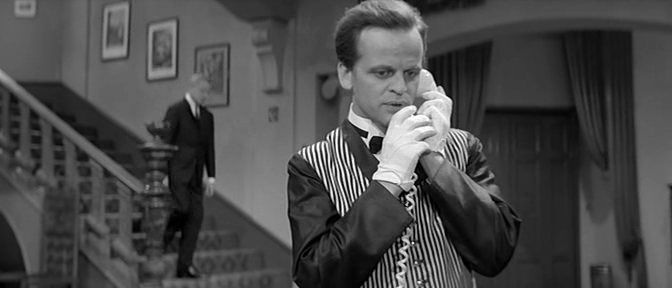
For those (most) of you who don't know, the Hexer (literally "sorcerer" in English) was a clever murderer in Der Hexer, a previous hugely popular Edgar Wallace krimi. He escaped to Australia at the end of the film. In this sequel, the wealthy Lord Curtain is murdered by his nephew and his butler (Kinski). They use the Hexer's modus operandi and leave his business card at the crime scene. Which brings back to mind that before there were omnipresent surveillance cameras, DNA traces and "mentalists" who can unmask killers by simple mind games, there used to be a time when criminals in movies would leave a card at the crime scene to brand their mischief. I remember distinctly several films from the 1950's and 60's I watched with my mother, who loves krimis, as a young kid where this was the case. It obviously left a strong impression on me because this simple detail brought back a lot of film watching memories from my childhood. In Neues vow Hexer, the titular character decides to fly back to London with his wife and Butler in order to prove his innocence.

What ensues are Edgar Wallace histrionics at their best. Heinz Drache plays his Inspector Wesby with all the arrogance, phony wittiness and misogyny he can possibly muster and Rene Deltgen as the Hexer is asked to make a fool of himself repeatedly but does so with a gleeful insouciance. Vohrer, who's oftentimes childish visuals have already been the highlight of many previous Wallace entries, does his job well and gives us several striking shots that mystify but ultimately stay with us (a room filled with men sleeping with a newspaper unfolded over their faces anyone?). During shooting, the director fell ill and had to be replaced by Will Temper who apparently quickly lost interest and was ousted by assistant director Eva Ebner and cinematographer Karl Loeb. As far as I could tell, the film didn't suffer from it significantly. I kept trying to spot sequences that seemed less lively than Vohrer's signature style but couldn't make out any.

Kinski, donning scruffy facial hair for this film, phones in his performance and is done with it by the halftime mark, when he is shot to death by Inspector Wesby. But we get one fabulously ludicrous scene at the very beginning, when the camera slowly pushes in on a coffin that magically opens to reveal Kinski lying in it. A man approaches him and Kinski sits up, smiles and utters: "It fits!" It's quintessential Edgar Wallace: it goes for the shock factor that grabs one instantly, it doesn't make any sense, it's vaguely poetic, and it never figures into the final denouement. Edgar Wallace krimis are a lot like American Horror Story at the moment: it's a collection of attention grabbing moments without a core. But in both cases, that can be enough for an entertaining viewing experience.

Kinski Watch XVIII - Das Verrätertor (1964, Freddie Francis)


It is interesting to survey the critical response to Das Verrätertor, the first installment of the Edgar Wallace series directed by a british director and shot entirely on location in London. Some laud the film as a zany and fast-paced thriller, while other characterize it as boring and by-the-numbers Edgar Wallace fare. Both sides are right to some extent. While something like actual suspense is never achieved in Das Verrätertor, it is a rather well-structured film (which can't be said about a lot of Wallace adaptations) and has some impressive sequences. It's pure camp, of course, and most characters are cartoonish beyond belief but that's to be expected from the Edgar Wallace movies.

Das Verrätertor is not a typical murder mystery and that might be one reason why it didn't really caught on with audiences at the box office. The film follows a bunch of criminals, lead by the greedy businessman Trayne, who prepare and execute a nifty plan to steal the crown jewels from the impenetrable London Tower. The plot, while rather pedestrian by today's caper movie standards, breezes by rather nicely, and Francis, a horror and suspense veteran, knows his way around a camera. Kinski assumes his usual role as a deranged killer and brings an impressive physicality to his otherwise unremarkable role.

There is one memorable scene in which Kinski's shooting someone is intercut with a surprisingly explicit striptease. The editing is crisp and Kinski's deadpan performance brings just the right amount of menace and mystery to the table. In another scene, the crooks rehearse the robbery in a room that has been built out just like the London Tower - in true Ocean's 11 form. The script emphasizes process more than anything else, which gets us a lot of scenes of the bandits observing and studying their target but unfortunately not a lot of suspense.

In another instance of world cinema name calling bloopers, Trayne calls Kinski's character "Kinski!" instead of "Kane", which is odd because the film was shot in English and later dubbed in German. Did he call him Kinski in the original or was the mistake made in the voice-over studios? In any event, it's one of those weird moments when one is instantaneously taken out of the movie and the grand illusion that is created when suspension of disbelief and film craft meet is broken.

Kinski Watch XVI: Die Gruft mit dem Rätselschloss (Franz Josef Gottlieb, 1964)


My quest to see every Klaus Kinski movie continues. Unfortunately, a lot of the movies he appeared in during the sixties are not available through the channels I usually get my movies from. Die Gruft mit dem Rätselschloss (in the off chance that there are German spelling fanatics among my readers I might note that the word “Rätselschloss”, which translates to mystery castle, is spelled with a double s in the credits and on the movie posters, which, at the time, would have been a spelling error. The right spelling would have been “Rätselschloß”. Notice the difference? Nowadays, the “ß” used instead of a double s has mostly disappeared), another entry in the seemingly endless Edgar Wallace series, is a rather labored affair that's not worth losing a lot of thought about. Audiences apparently had the same reaction at the time of the release. Die Gruft mit dem Rätselschloss is one of the few flops of the Edgar Wallace series.

The story could have been interesting but is treated with pure inaptitude. Real, the owner of a casino, betrayed and deceived his customers with fishy practices in his establishment, basically extorting money from them and living large. Did the 99%ers kill him in a fit of rage? No, he simply dies of old age but regrets his deeds just in time and sends his daughter to distribute his considerable wealth hidden in an booby-trapped vault among the ones he wronged. But before she can do so she is kidnapped by a gang of ruffians who also feel betrayed by Real and want to force her to give up the riches to them. As you might imagine, wackiness and deaths ensue.

But the film has no atmosphere, no suspense, no real humor. Die Gruft mit dem Rätselschloss gets off to a good start though. It begins with a riveting shootout between cops and gangsters. Just when the obligatory helpless girl-caught-in-the-crossfire is saved, “The End” is superimposed over the screen. The camera pulls back and we realize that we are in a movie theater where, as it turns out, one of the patrons has been murdered. In the opening twenty or so minutes, we also get a lot of cool (for a lack of better term) shots, using steep camera angles and medium shots. But it’s almost as if the film was shot chronologically and Gottlieb lost interest as filming went on. By the end, the direction is plain dull. And Kinski? He is mostly reduced to staring at the action from afar.

Not recommended viewing at all.

Kinski Watch XV: The Black Abbot (Franz Josef Gottlieb, 1963)


By the time this fifteenth installment of the Edgar Wallace series rolled along, a significant change of priorities had taken place. The earlier films were straight-forward murder mysteries with a narrative driven by a strong central character, the lead detective (usually played by Joachim Fuchsberger) who was following a clear objective and had to face a few clearly identified antagonists (usually involving menacing stares from Klaus Kinski).

Over time, however, the Edgar Wallace films became increasingly preoccupied with quirky secondary characters that were supposed to aggregate the plots, but mostly revealed themselves to be pointless to the story or the denouement of the murder mysteries. All smoke and mirrors, the krimis lost the core of a driving main character, as the respective detectives in charge were relegated to the peanut seats.

The Black Abbot, finally might one say, discards any aspirations of being a straight murder mystery and concentrates on the connivery between the main characters. There is a murder, there is a crime plot, but the intrigues and double crossings between the characters take the forefront and the killings serve more as an atmospheric backdrop. Consequently, the Scotland Yard detectives present in the film play a marginal role at best.

The film opens with a murder committed in an abbey. The detectives in charge of the case inexplicably take quarters in a nearby manor of Lord Chelford who is convinced that a mysterious black abbot is responsible for the killing. The police, however, suspect that a treasure that is supposed to be hidden in the abbey might be the motive of the murder. And they might be right. The Lord's attorney Arthur, crushed by debts, arranges the marriage of his sister Leslie to the elderly Lord Chelford. But Leslie fancies Lord Chelford's cousin Richard. Arthur's associate Fabian also takes interest in Leslie and teams up with Lord Chelford's former secretary in order to find the legendary treasure that is supposedly guarded by the black abbot.

Klaus Kinski plays Lord Chelford's butler who, spoiler alert!, turns out to be the titular black abbot when, another spoiler alert!, he is killed later in the film. His creepy performance here is enhanced by the nasal voice pitch with which he delivers his lines. In the documentary My Best Fiend director Werner Herzog recounts how fanatically Kinski would rehearse speech patterns, sometimes 10 consecutive hours a day. And Kinski's astounding vocal versatility becomes evident listening to his poetry albums on which he performs virtually every piece in another vocal style. Although he despised the work on film sets, Kinski had enough professionalism and pride in his craft to never undercut a certain quality level. And sometimes a detail like the sound of his voice makes that evident.

Stylistically, The Black Abbot, directed by Franz Josef Gottlieb, is less frantic than the films helmed by Alfred Vohrer and more concerned with composition and evocative camera movement. Where Vohrer's first impulse is to go for the most shocking visual gag, Gottlieb relies more on camera blocking and deep focus, and lets the scenes play out in elongated yet cadenced takes. The editing is simple yet effective and the film overall abandons the pulpy B-Movie esthetic that the series had cultivated until then.

The German critics at the time, however, deplored exactly that. One main objection to the film at the point of its release was that it wasn't exciting and engaging enough. On the one hand, I can understand the critique, as The Black Abbot feels less like a visceral thriller, and more like a cerebral and detached anatomy of a murder, which is a sometimes jarring change in pace for the series. But I appreciate Gottlieb's craft and applaud his willingness to break free of the usual Edgar Wallace formula. In the end, I think, The Black Abbot has a certain undeniable charm that qualifies it as a superior guilty pleasure.

Kinski Watch XIV: The Indian Scarf (Alfred Vohrer, 1963)

The Indian Scarf does something every crime series likes to do after a while: locking a number of people in a remote location with no way out and killing them off one by one. Who is the murderer among them? Animosities build up, the tension rises until the identity of the killer is unveiled, and it’s all a little silly. Edgar Wallace being who he is, and Alfred Vohrer being who he is, the silliness level was cranked up to the max in this film, although screenwriter Harald G. Petersson, at first, manages to draw clear and compelling relationships between the characters that should have hold our interest. But as the body count keeps rising, the suspense dwindles. Never a good sign.

The wealthy Lord Lebanon is murdered and his nine heirs all travel to his estate where his attorney is to unveil the Lord’s last will. The nine people present are an eclectic mix of blue bloods, relatives by marriage and other in-laws, and the disputes erupt immediately. Lord Lebanon’s testament stipulates that all our nine protagonists are to spend six days and six nights in peace with each other on the estate before they can collect their part of the presumably substantive inheritance. A conveniently ferocious storm makes sure that there is no way out of the estate, as well as no working phone lines. Our nine heirs are truly and utterly secluded. So let the bloodletting begin.

It is a shame that script and direction don’t manage to make this whodunit any fun. Eddy Arendt as the silly butler is amusing at times but The Indian Scarf lacks the liveliness or atmosphere of the previous Edgar Wallace krimis. As always, the explanation delivered for the murders is of no  interest at all and one is left wanting for a little more substance. In the end, only two people are present for the reading of the will, and Lord Lebanon had somehow anticipated that most of his family would have been killed off after the six days and night. So the majority of his riches go to…tadah!: Edgar Wallace. Heinz Drache as the slick attorney smirks at the camera as he reads this, and it’s really not cute or clever, it’s a full-blown eye roller.
Kinski is not the bad guy for once, just a deranged artist who married into the family and is despised by all. His death is one of the silliest in the film: he is found inside one of his sculptures, which would require that he had left them hollow from the beginning should he (or his killer) ever need access to the sculpture's bowels - but let's not lose ourselves in questions of plot plausibility here.

All in all a rather forgettable offering. As much as I complain about the general quality of the German Edgar Wallace krimis, I mostly have a good time watching them. They have a nonchalantness and irreverence that make them enjoyable and somewhat addictive. But The Indian Scarf is just dull.

Kinski Watch XIII: The Squeaker (Alfred Vohrer, 1963)


The Squeaker is the fourteenth Edgar Wallace krimi produced in Germany and the series found its footing by then. The formula consisted of blending B-Movie shock values with fabricated suspense and knee-jerk humor, and rotating the same stock of actors embodying the exact same roles from film to film, thus creating a certain cushiness to the series, comparable to contemporary procedural crime shows on TV like CSI or NCIS. Every episode is more or less the same, and coming in, the viewer knows exactly what to expect.

What The Squeaker does differently is pushing the envelope in the cheap shock department, as the plot mercilessly exploits every red herring imaginable, coming up with twists and reversals that make no sense whatsoever but spellbind the viewer into believing that the story has purpose and moves towards a meaningful reveal.

It is telling, then, that Inspector Elfords (Heinz Drache) who traditionally should be the driving force of the film, as the main question remains “who is the squeaker”?, is completely side tracked and intervenes only sporadically, leaving ample screen time for the supporting cast and their soap-like ever changing alliances and betrayals.  

The story concerns an Omar from The Wire-like outlaw who robs criminals about to engage in an exchange of illegal goods. One of those criminals, however, has unveiled the “Squeaker”’s real identity and is about to make it public but is murdered just in time with the poison of a black mamba that was stolen from the store of Frank Sutton who trades in animals, and the typical Edgar Wallace smoke-and-mirrors-fare ensues.

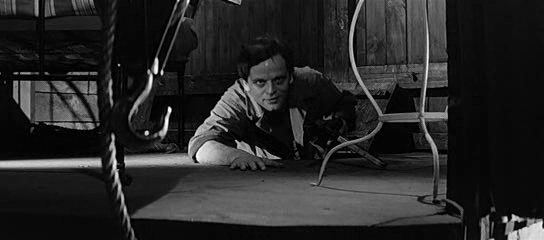
Kinski, again, plays more or less the proxy bad guy and his role is only of interest because he hasn’t got a single line of dialogue during the entire movie. His face, nay, his eyes, do all the work and nothing is lost in the (relative) intensity of his performance. And the way he crawls out of the shadows in one scene and shimmies over two turtles brooding on the floor is equal parts creepy and astounding.

Kinski does a lot of crawling out of hideouts, tiptoeing pressed against walls and observing from the shadows, but his dirty work is never kept a secret, which is about the only straight forward information we get from the script. When the identity of the "Sqeaker" is unveiled at the end, it is equal parts absurd and oddly satisfying, as one early shot that one mistook for simple misleading reveals to be, well, revealing. Ultimately however, the hide-and-seek of The Squeaker was pushed too far to still take it seriously. But, at this point, complaining about it would be like complaining about Horatio Cane's suave donning of his shades right before the main credits of CSI: Miami kick in.

Kinski Watch XII: Scotland Yard Vs. Dr. Mabuse (Paul May, 1963)


As Jeffrey Sconce brilliantly describes in his book Haunted Media, new technologies have always been a source of great wonder and terrible fears. With each technological advancement, popular media in general and Hollywood (America’s “subconscious” as embattled film critic Armond White puts it) in particular represented the new gadgets as containing a disembodied Unknown capable of invading the safe haven of our homes and/or bringing terror and fear to our lives. Radios could establish contact with the world of the dead, televisions could suck humans into an otherworldly void, and the internet was capable of infiltrating our minds and perverting the country’s youth.

Every decade has had its own technological obsessions, and with that the Hollywood pendant of “conscious” or “awakened” technologies out to get you (just watch how much home improvement technologies, greatly en vogue in the 1990’s, were utilized in the X-Files as a source of terror and death), but the 60’s put a man on the moon and saw the advent of the first video game – both starting points for the increasing “technologization” of our lives.

With spacecrafts, barcodes and videogames altering the perception of what man made technology could accomplish, surely, inventing a machine that could control a human being’s mind was not too outlandish a concept. Scotland Yard vs. Dr. Mabuse, the fifth installment of a Dr. Mabuse series for German television, tapped into this fascination of technologies gone wrong, as the spirit of the megalomaniac Mabuse takes over the body of Professor Pohland who gets a mind-controlling machine in his possession. Now able to turn hordes of policemen into docile servants of his cause (namely destruction and mayhem), seemingly nothing can stop him.

And if that over-the-top premise didn’t already tip you off to the film’s rather conservative politics, wait until you hear the solution to the problem of the mind control. As it turns out, wearing a hearing aid makes one immune against the brain seizing waves of Mabuse’s evil apparatus. So the leading detective’s mother, a wacky old lady reading too many crime novels but always a step ahead of the real police, zips by and brings Scotland Yard a suitcase filled with hearing aids which they dutifully wear to defeat Mabuse.

But one can say this in the movie’s favor: within its ludicrous conceit, Scotland Yard Vs. Mabuse manages to build a more or less coherent narrative with clear goals for the characters, some juicy plot twists, and a reasonable amount of tension towards the end. However, Paul May’s uninspired directorial work can’t do the movie any good, and a lot of the performances are too hammy to be taken seriously. 
 
Kinski, in a welcomed reversal of his usual 60’s villain film work, plays a cop who falls under Mabuse’s spell, but is rescued just in time and helps to defeat the villain. It’s rather light fare that lacks the charm of his Edgar Wallace performances because he can’t infuse the role with the detached irony he exhibits in the other films.

Kinski always said that the only criteria for accepting a film role was how much money it paid. And after watching a good dozen of these krimis, and comparing them to his recitals of Francois Villon poems, or his reading of Romeo and Juliet of the time, one can begin to understand why he despised film so much. He was a force of nature when he performed material that suited him. Unfortunately, all these German krimis didn’t suit him at all.

Kinski Watch XI: The Inn On The River (Alfred Vohrer, 1962)


A quick lesson in plot construction:

Scene 1: Inspector Wade (Joachim Fuchsberger) and Dr. Collins (Richard Munch) discuss mysterious murders committed with a harpoon. The killer is dubbed the "Shark" and has, until now, always eluded Scotland Yard.

Scene 2: At the Mekka, the titular inn on the river, owner Nelly Oaks (Elisabeth Flickenschildt) performs a seductive song, while her innocent step daughter Leila Smith (Brigitte Grothum) has to fight off advances from horny seamen. Wade stops by to interrogate both about a murder committed by the "Shark" not far from the Mekka. No one has heard anything, of course, and if they have, they're not willing to share any information with the police. Wade also makes the acquaintance of Gregor Gubanow (Klaus Kinski donning a mustache), a mysterious businessman who seems to know more about the murder than he is willing to spell out.

Scene 3: Leila is commanded to the cellar to make an inventory. While she is there alone, camera work and music strongly imply that the "Shark" is preying on her. Just as he is about to grab her, Wade appears to question Leila. Do we get to see the "Shark"'s face? Yes: it's Kinski. Leila tells Wade that she saw the "Shark" on the night of the murder. Wade urges her to keep it to herself, lest the "Shark" will most likely kill her.  But the "Shark" is presumably already listening to the entire conversation in the shadows.

Thus, the intrigue is set up in a few story beats and after ten minutes one knows exactly in which direction the story is heading. But Edgar Wallace wouldn't be Edgar Wallace if there wouldn't be numerous complications along the way. The problem is that these plot twists and reversals aren't integral to the outcome of the story, namely the reveal of the "Shark"'s identity.  Granted, we learn that Leila is the unsuspecting inheritor of a large sum of money and we suspect that the "Shark" eliminates everyone around her to get to that money. But it is never explained and the killings ultimately make no sense.

The Inn On The River, while more focussed than The Door With Seven Locks for example, is still a rather sensationalist whodunnit that sacrifices plausibility for shock value and is wholly uninterested in explaining any of the character motivations. The reason why Wade gets involved at all is because he fancies Leila (who, by the way, is not even of legal age) and fears for her well-being. And because the plot demands it, both kiss at the very end of the movie, although no real relationship developed during the film.

At first, Kinski plays his typical Edgar-Wallace-Kinski sleazebag, but in an interesting plot twist, we discover that he is a police officer who supposedly worked undercover the whole time. Did Wade know that? It's not clear. Kinski's character dies in a chase with the "Shark" (oops, spoiler alert). When Wade sees the body he mutters: "It's a pity. He was one of our best men". But what was he doing posing as a shady business man before? Was he feeding Wade with information from the underworld, or is it just one plot point more that is not supposed to make sense and is merely introduced to shock and wow? In any event, Kinski's character is never mentioned again after his sudden death and the investigation immediately continues as is he had never existed.

Quiet some fun is to be had doing the guessing game of who the "Shark" might be, and after the one hour mark, we quickly burn through several candidates who are then either killed immediately by the real "Shark" or are proven innocent. And the only palpable character trait Wade has is his frustration with the fact that Scotland Yard is seemingly unable to catch the killer, which is nicely exploited at the end of the movie when it looks like Wade won't be able to lay his hands on the "Shark" although he mobilizes a sizable amount of police officers to surround the harpoon-wielding murderer.

The "Shark"'s real identity is a disappointment and a little ridiculous. It makes no sense from a story point of view and is not satisfactory on an emotional level. Audiences, however, didn't seem to mind. The Inn On The River was the most successful Edgar Wallace krimi of the series with over 3.5 million tickets sold at the box office in 1962.

Kinski Watch X: The Door With The Seven Locks (Alfred Vohrer, 1962)


A thoroughly enjoyable movie, the script for The Door With The Seven Locks still exhibits major structural problems, bereaving the film of any real suspense. There are two sides to the Seven Locks coin: the first half of the movie, a swift and pulpy affair that comes up with silly humor and effective photography sets up the intrigue rather nicely and hopes are raised for a consistently thrilling thriller – if you’ll excuse the pun. In the second 45 minutes, however, the plot gets unnecessarily convoluted and confusing, and the movie loses its tension and focus until the fun silliness of the first half loses all its fun.

The plot concerns the heirs to the deceased Lord Selford whose wealth is supposedly kept in a vault only accessible if one possesses seven keys necessitated to unlock the vault’s door. One by one, the heirs turn up dead with one of the seven keys on them. Inspector (not commissioner, as he specifies) Dick Martin (Heinz Drache) begins his investigation. His aides are a librarian with spellbinding legs (Sabina Sesselman), Martin’s goofy sidekick Holmes (Eddi Arendt, of course) and the shady attorney Haveloc (Hans Nielsen) who manages Lord Selford’s will.

All is well and the story breezes along until somehow Dick Martin and Holmes, who’s shenanigans are at times amusing and maddening, are relegated to be simple onlookers as a crazy scientist, a moronic hulk of a hit man, and a couple of rich aristocrats and their butler who stage several abductions find their way into the script and pretty much take over and complicate things where we just wanted to see Holmes trying to learn magic tricks while discussing clues with Martin, and feel vicarious embarrassment observing Martin hit on the allowedly charming librarian Sybil. It is telling, in that regard, that the solution to the murder intrigue comes about not thanks to Martin’s investigative skills, but because he is simply in the right place at the right moment. Not that I’m against experimentation in the way to tell a crime story, but if the leading detective doesn’t even interfere in the plot for large chunks of the film and turns up at the end to resolve everything by pure chance something went wrong.

Kinski’s presence in the movie is peripheral at best. He has one extended speaking scene, where his character Pheeny reveals to Dick Martin that he was commissioned to break open a door with seven locks but refrained from accepting because the whole affair seemed fishy. A few scenes later and not even ten minutes into the movie, Martin finds Pheeny was murdered. Given Kinski’s self-proclaimed proclivity to lure female bit players into his bed during shooting, maybe he didn’t agree to a bigger role because the only young female actress on the set was Sabina Sesselman and the prospect of spending weeks on a set where carnal release was not possible in the amount desired drove Kinski away from this one.

Or it could be that shooting for The Door With The Seven Locks had to be rescheduled repeatedly (initially, the film was supposed to be done by the end of 1961) because producer Horst Wendlandt wasn’t satisfied with the script. The Mystery Of The Red Orchid was rushed into production instead, providing Kinski with a much bigger role than he had previously had in any Edgar Wallace krimi. Even before the latter film hit theaters, shooting for Seven Locks began. It is no surprise then that a lot of actors typically cast in Edgar Wallace films were absent (Heinz Drache replacing Joachim Fuchsberger as the quirky detective) and Kinski had only a very small role. Though rejected by critics, Seven Locks was hugely successful at the box office, reaffirming the public's hunger for Edgar Wallace murder mysteries after the commercial failure of The Mystery of the Red Orchid.

Kinski Watch IX: The Mystery of the Red Orchid (Helmut Ashley, 1962)


A group of gangsters are playing poker in a hotel room. Whiskey, Fedoras, cheap three-piece suits - the whole nine yards. After a few witty exchanges, the door swings open and a group of rivaling gangsters with automatic weapons mow them down. Cut to main credits - it's on. The tenth Edgar Wallace krimi The Mystery of the Red Orchid abandons the murder mystery formula for the first time and comes up with a classic gangster story. And isn't shy of wearing its influences on its sleeves. Chicago gangsters terrorize London millionaires demanding protection money. If they don't pay or go to the police they're murdered. And all through the movie, the British cops underline the fact that these methods are "American" methods. And to counteract, an American detective is brought in. Kinski plays "handsome Steve", right hand man of the mobster boss. Not a very juice role but that probably has to do with the production history.

After the wide-spread success of The Strange Countess, producer Horst Wendlandt wanted to follow up with The Door With Seven Locks. But he wasn't satisfied with the script. The contracts with the entire crew supposed to work on the film, however, were already signed. Thus, In order to fulfill the contracts, and because theater owners in Germany had already reserved the date for the next Edgar Wallace premiere, Wendlandt decided to go ahead with the filming of The Mystery of the Red Orchid instead, as he felt that the script was much stronger. Unfortunately, the movie was not well received and was the least financially successful Edgar Wallace krimi to date.

It has often been mentioned that, although a German production and mostly filmed in Hamburg, none of the main actors in The Mystery of the Red Orchid are German (Kinski is originally from Poland, Marisa Mell Austrian and Christopher Lee is, of course, British) - another oddity in this out and out strange production. Clearly an homage to 1940's and 50's action pics from Hollywood, the movie is an unfortunate melange between the typically convoluted Wallacian "mystery" fare, riddled with plot holes and inconsistencies, and a rather sad attempt at capturing the exciting and menacing atmosphere of American gangster flicks. The script, as well as Helmut Ashley's uninspired directional work are an utter disappointment.

However, The Mystery of the Red Orchid remains a fascinating contemporary document illustrating how the German krimi industry (by 1962 well-alive and swinging) interpreted and aped Hollywood fare. One could, rather boldly, propose that the German postwar fascination with everything American was concentrated on the superficial, as the elements that were lifted from American mobster movies were limited to clothing, mannerisms, plot tropes and zingy one-liners - nothing of substance. If the atmosphere of that type of movie was of obvious interest to the movie makers, Hollywood-type story (what one could tentatively call "substance") was not. But surely I'm reading too much into this. The Mystery of the Red Orchid is, after all, a failure on all counts.